
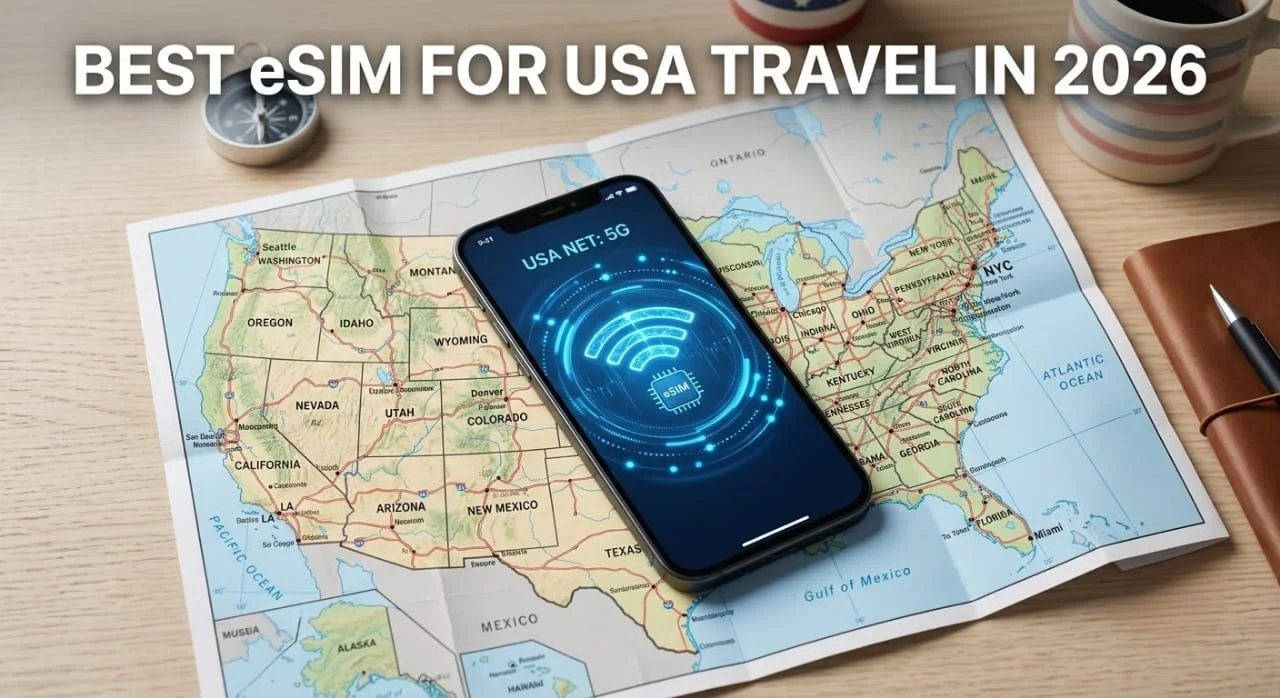
Picking an international eSIM for a US trip comes down to three things: does it cover where you’re actually going, does the eSIM data plan match how much you’ll realistically use, and does it let you tether a laptop without hitting a wall halfway through the trip. We’ve broken down four of the most searched eSIM providers for USA travel below, with real pricing, real coverage details, and the honest tradeoffs each one comes with.
We’re including ourselves in this roundup. LuxxeSIMs is built specifically around flexible, usage based eSIM data plans for US travel, and we think it earns its place here, but we’ve tried to give every other provider a fair, accurate look based on what real users and independent reviewers say about each one, not just our own marketing copy
The eSIMs that work well share three traits: they activate quickly, hold a stable signal where you’re actually going, and price the data in a way that matches your trip. Everything else is secondary.
A travel eSIM is really just a digital version of the SIM card you’d normally pick up at an airport kiosk, minus the queue, the cash exchange, and the slightly stressful negotiation in a language you don’t speak. You buy it online, scan a code, and you’re connected to a local network the moment you land, which is a far cry from how things worked even five or six years ago.
In practice, the real differences between providers show up in three places: how the plan is structured (per-gigabyte vs. flat rate unlimited), whether hotspot or tethering data is capped separately from your regular data, and how much support you get if activation doesn’t go smoothly the moment you land. We learned this one the hard way ourselves early on, “unlimited” sounds simple until you read the fine print and realize tethering runs on a completely different allowance. Most providers throttle speeds once you cross a daily threshold, and that tethering cap especially catches people off guard, since the marketing rarely leads with it. If you’re planning to work off a hotel Wi-Fi backup, share a hotspot with someone you’re traveling with, or stream a lot of video, that distinction will matter more to your actual trip than the price on the box.
LuxxeSIMs prices its USA eSIM plans based on actual usage rather than a flat premium, with straightforward QR code activation and no separate hotspot cap layered on top of your data. It’s a newer name in this space, so the public review volume is still smaller than older competitors.
Ease of setup: Activation runs through a standard QR code sent after purchase. On an iPhone, you scan the code, tap “Add eSIM,” and you’re online within a couple of minutes. On Android, it’s nearly identical through the device’s built-in eSIM settings. No proprietary app is required, which keeps the process closer to a normal carrier SIM than some app gated competitors out there.
Price: Plans are usage based rather than sold purely as flat-rate bundles, so the cost tracks more closely with how much you actually use rather than charging every traveler the same rate regardless of consumption. In our experience this tends to work out cheaper for travelers with a moderate, predictable usage pattern rather than someone maxing out a flat unlimited tier every single day.
Connectivity: Coverage runs on national US carrier infrastructure, the same networks a domestic SIM would use, so signal strength in any given city or region comes down to carrier tower density rather than anything specific to LuxxeSIMs. Beyond the USA, we also cover the UK, Europe, and Germany for anyone continuing on to a multi-country trip.
The honest limitation here is review volume, and we’re not going to pretend otherwise. Because we’re newer, there isn’t the multi-year backlog of public reviews that older brands have built up, so independent verification is thinner than you’d find elsewhere. The feedback we do have points to fast airport activation and stable connections, but if you’re someone who wants to read through hundreds of reviews before committing, that depth simply isn’t there yet on our end.
Best for: Travelers who tether a laptop often, use a moderate to heavy amount of data, or want an eSIM data plan that scales with real usage instead of a flat rate.
Holafly has operated in this market since 2018 and has built one of the largest review bases in the industry, with generally strong ratings on Trustpilot. Its core model is a flat rate unlimited data plan sold by duration rather than gigabytes.
Ease of setup: After purchase, Holafly sends a QR code by email. iPhone setup involves pressing and holding to add the eSIM profile, which typically takes two to three minutes; Android works the same way, or through the Holafly app if you’d rather. No app is strictly required for installation.
Price: The unlimited plans are sold in fixed durations rather than by data volume, so pricing scales with the length of your trip rather than how much you use day to day. It’s an easy structure to budget against, no mental math involved, but it sits at a premium compared to per-gigabyte alternatives, especially for shorter trips or light data users who don’t really need a full unlimited tier in the first place.
Connectivity: Holafly partners with major national carriers in each market it serves; in the US, that means leading carrier infrastructure for both 4G and 5G depending on your device and location. Coverage tends to hold up well in metro areas and along common travel routes.
The recurring issue across independent reviews is the hotspot allowance, and it’s worth knowing before you buy rather than discovering it mid-trip. Tethering data is capped separately from on device data, typically landing around 500MB to 1GB per day depending on the plan, which catches people off guard since the headline marketing leans hard on “unlimited” without flagging that distinction. A handful of users on Reddit and Trustpilot have also mentioned speed throttling during busy periods, which Holafly attributes to local network fair use policies rather than anything on its own end.
Best for: Travelers on shorter trips who want flat-rate simplicity and don’t plan to hotspot heavily.
Airalo launched in 2019 and is one of the most recognized names in the space, operating as a marketplace that sells plans from multiple underlying network partners rather than running its own infrastructure. It covers more than 200 countries through local, regional, and global data plans.
Ease of setup: Purchase generates a QR code, viewable either by email or directly in the Airalo app. iPhone and Android installation both follow the standard eSIM flow and typically complete in under three minutes. The app isn’t required for basic activation but is genuinely useful for tracking usage and topping up later.
Price: Airalo sells primarily per-gigabyte plans with validity windows that vary by destination, which tends to be cheaper upfront than flat-rate unlimited competitors if you’re a light data user, but it does mean keeping an eye on usage so you don’t get caught needing a top-up mid-trip. Unlimited options exist for select destinations, with a daily fair-use threshold (commonly cited around 3GB) before speeds get throttled.
Connectivity: As a marketplace, Airalo’s actual network partner varies by country and plan; in the US specifically, it offers plans on more than one underlying carrier depending on plan type, which is handy if you’re road-tripping through varied terrain and don’t want to bet on a single network. Reviews note generally reliable speeds in metro areas, with more inconsistency once you’re off the beaten path.
The most common complaint across reviews is reaching an actual human, since Airalo’s support is chatbot first before escalating to a person, which can feel slow if you’re stuck without signal right after landing and just want a real answer. Trustpilot ratings land in a roughly average range, reflecting a mixed but generally workable experience rather than uniformly glowing feedback.
Best for: Travelers who want the widest catalog of country specific and regional eSIM data plans in a single app, with brand name backing and per-gigabyte pricing control.
Saily is a prepaid eSIM service built by Nord Security, the company behind NordVPN, covering data plans in more than 150 countries through an app-based setup with instant QR code delivery. In the US, Saily connects to major national carrier networks, with pricing starting around $4.99 per 1GB.
Ease of setup: The Saily app handles plan purchase, QR code delivery, and installation in one flow, and setup is generally reported as taking under five minutes through the app interface. You can also do this over Wi-Fi before you even leave home, since the validity window only starts once you connect at your destination.
Price: Saily is consistently one of the more budget friendly options out there, with entry level US pricing around $4.99 per gigabyte and larger bundles (20GB for 30 days, for example) priced competitively against other per-gigabyte providers. Saily Ultra, a separate monthly subscription tier, bundles a larger monthly allowance with NordVPN’s broader privacy suite for anyone who wants more than just data.
Connectivity: Saily’s USA plans connect to established national carrier networks, and its Trustpilot rating sits notably high, around 4.7 out of 5 from tens of thousands of reviews, which is a genuinely strong showing for a relatively young product.
The clearest limitation is that Saily’s core USA plans are data only, with no US phone number, calls, or SMS included on standard plans. That’s fine if you live entirely through WhatsApp and Google Maps, but it can trip you up if you need to call a hotel, take a delivery driver’s call, or get an SMS verification code from a US business. Saily has begun piloting an optional US phone number add-on, but it isn’t standard across all plans yet, so check before you assume it’s included.
Best for: Budget conscious, app first travelers who don’t need a local phone number and want the added privacy tools that come bundled with the NordVPN built platform.
| Comparison Point | LuxxeSIMs | Holafly | Airalo | Saily |
| Pricing model | Usage based, scales with actual data use | Flat rate unlimited, sold by duration | Mostly per GB, select unlimited plans | Per GB, plus Ultra monthly subscription |
| Hotspot/tethering | No separate restriction on tethered data | Capped, typically 500MB–1GB/day | Allowed, subject to overall fair use cap | Allowed on data only plans |
| US phone number | Not included | Not included | Available on select plan types | Not standard; optional add on in select markets |
| Review volume | Smaller, growing review base | Large, well established on Trustpilot | Large but mixed (roughly average rating) | Large and strongly rated (~4.7/5) |
| Best suited for | Heavy tetherers, usage based pricing | Short trips, flat rate simplicity | Wide plan catalog, per GB control | Budget pricing, built-in privacy tools |
A lot of travelers search by city or state rather than just “USA,” which makes sense, your data needs in San Francisco’s dense urban grid look pretty different from a road trip through rural Florida or a multi stop hop around California. Here’s the thing though: none of the four providers above sell separate city or state specific plans. An eSIM for San Francisco, an eSIM for New York, or an eSIM for California is the same nationwide USA eSIM, since coverage runs on national carrier networks rather than anything tied to a specific city.
What actually changes by location is signal density and carrier tower coverage, not the plan itself. Cities like San Francisco and New York sit on dense 5G infrastructure from every major US carrier, so speed differences between providers tend to be minor in practice within city limits, you’re unlikely to notice much difference walking around downtown. California and Florida are trickier because they combine dense metro areas with long rural stretches, and that’s exactly where the hotspot caps and fair use thresholds we covered above start to matter more than the headline price, especially if you’re driving between cities and leaning on maps and navigation for hours at a stretch.
If you’re planning a trip to any of these destinations, the practical move is just to pick a solid nationwide plan rather than search city by city, since the plan itself doesn’t change once you land.
Travelers heading to the US from the UK usually start from a different baseline than most: UK carrier roaming rates for the US tend to be expensive or capped at a low amount, which makes a dedicated UK eSIM for USA travel worth setting up before you even leave rather than just relying on your home network and hoping for the best. All four providers covered here are available to UK travelers and can be installed before flying, with the plan only kicking in once you land and connect to a US network.
The two things actually worth checking as a UK traveler are device compatibility (most iPhones from the XS onward and most recent Android flagships support eSIM, but it only takes a minute to confirm your specific model) and whether a USA only plan covers your full itinerary or whether you need something broader if you’re also stopping in Canada or Mexico. Buying and installing the eSIM ahead of time means you land, connect straight away, and skip the airport SIM kiosk entirely, which, if you’ve ever queued for one after an overnight flight, is reason enough on its own.

If your trip is US only, the deciding factor usually isn’t coverage, since all four providers above offer nationwide plans for the USA. The real differentiator is how each one handles hotspot use and whether the pricing model fits a quick city trip versus weeks on the road.
For a UK eSIM or a broader eSIM Europe plan, check whether you need a single regional plan covering multiple countries or separate country specific plans, since that choice affects total trip cost more than which brand you pick. If your trip includes Germany specifically, network performance tends to come down to local carrier partnerships rather than the eSIM brand itself, so it’s worth checking recent destination specific feedback rather than assuming a brand’s general reputation carries over evenly across every country it serves.
There isn’t a single best eSIM for international travel that fits every traveler, the right plan really depends on how you actually use data on the road. If you tether a laptop regularly, travel for weeks at a stretch, or want pricing that scales with real usage, LuxxeSIMs is built for exactly that. If flat rate simplicity matters more to you than a hotspot cap, Holafly’s long track record speaks for itself. If you want the widest catalog of country specific plans with per gigabyte control, Airalo’s marketplace model is hard to beat. And if budget pricing and built-in privacy tools top your list, Saily is worth a close look.
1. Is there a separate eSIM for San Francisco, New York, or California?
No, none of the major providers sell city or state specific plans. An eSIM for San Francisco or an eSIM for New York runs on the same nationwide USA eSIM data plan, since coverage depends on national carrier networks rather than local only infrastructure.
2. Can UK travelers use these eSIMs for a US trip?
es, all four providers covered here work for UK travelers heading to the US and can be installed before departure, with the plan activating once you land and connect to a US network.
3. What’s the difference between a per GB and a flat rate unlimited eSIM data plan?
A per GB plan charges based on the data you actually use within a set validity window, while a flat rate unlimited plan charges a fixed price for unrestricted on device data over a set number of days, often with a separate, smaller cap on hotspot or tethering use.
4. Do international eSIM plans work the same way as a physical SIM card?
Yes, an eSIM connects to the same local carrier towers a physical SIM would use; the difference is that it’s installed digitally via a QR code or app rather than inserted as a physical chip, and it can typically be set up before you even leave home.
5. Will my phone work with these eSIMs?
Most phones from the last few years support eSIM, including iPhone XS and later and most recent Android flagships, but it’s worth checking your specific model and confirming it’s carrier unlocked before you buy, since a locked phone won’t accept a second eSIM profile.

The top 10 eSIM providers in Germany for tourists and travelers in…

The best eSIM for France depends on how long you’re staying and…

If your eSIM doesn’t work when you land, don’t panic. It’s usually…

The best eSIM for a Mediterranean cruise in 2026 is a regional Europe eSIM that covers all the countries on...

If you’re flying into JFK and you haven’t sorted your mobile data yet, stop what you’re doing. Seriously. Roaming charges...

Slow internet while working remotely in the Netherlands usually comes down to a few simple things, wrong plan, weak network,...