

If you’re comparing LuxxeSIMs vs Airalo California, here’s the thing you should know right away, both providers offer USA wide eSIM plans that work across all 50 states, not California-specific plans. So, the best eSIM for California isn’t really about California as such, it’s more about how you use your data, how long you’re staying, and honestly, how you like to manage your plan.
A lot of people assume there’ll be some kind of “California plan,” but that’s not how it works. These are country-level plans, so once you’re connected, you’re good to go pretty much anywhere in the US.
For most travelers in 2026:
This is where the real comparison should focus, not on where the eSIM works, but on how efficiently it supports your travel needs.
As highlighted in real world travel comparisons, eSIM providers don’t operate on city level plans, they operate on country level carrier agreements.
Both LuxxeSIMs and Airalo provide United States coverage, meaning:
This aligns with real world testing insights where coverage is tied to local telecom infrastructure, not the eSIM provider directly. So when comparing LuxxeSIMs vs Airalo California, the focus should shift from “where it works” to how it performs and how plans are structured.
| Feature | LuxxeSIMs USA eSIM | Airalo USA eSIM |
| Coverage Scope | Entire United States (all 50 states) | Entire United States (all 50 states) |
| Data Structure | Flexible plans + unlimited options | Fixed data tiers (GB-based) + some unlimited |
| Pricing Logic | Variable pricing based on usage & duration | Predictable per-GB pricing |
| Usage Style | Best for heavy usage & longer trips | Best for light usage & short trips |
| Plan Management | Simple QR setup, minimal interface | App-based control + easy top-ups |
The biggest difference, just like in other eSIM comparisons, is how you pay for data. LuxxeSIMs leans more toward flexibility. You’ll see a range of plan options, including higher data limits and even unlimited ones. It works well if you don’t want to keep checking your usage all the time, especially when you’re out exploring, using maps constantly, uploading content, or maybe even working on the go. You just use your phone normally without that constant “how much data is left?” thought in the back of your mind.
Airalo, on the other hand, follows a per-GB pricing model. It’s quite similar to buying a local SIM, just in a digital format. The upfront cost is usually lower, which is great, but yeah, you do need to keep an eye on how much data you’re using. Once you hit your limit, you either slow down or need to top up, so there’s a bit more involvement there.
Choosing the right eSIM plan for USA depends on how you actually use your phone while traveling.
LuxxeSIMs works better if you:
Airalo works better if you:
And if you look at it more broadly, this follows a pattern you’ll see in most eSIM comparisons:
Understanding how does eSIM work is simple on paper… but what really matters is how it feels when you’re actually traveling.
The basic process is the same for both providers:
I’ve used a few different eSIMs while traveling, and over time, I’ve found myself leaning more toward LuxxeSIMs, not because others don’t work, but because the overall experience just feels a bit more flexible and less restrictive. What I usually do now is install the eSIM before my flight. With LuxxeSIMs especially, I’ve noticed this makes things smoother, once I land and switch on mobile data, it connects without much effort. No need to look for airport Wi-Fi or SIM kiosks, which honestly saves both time and energy after a long trip.
In actual use, the difference becomes more noticeable over time. With LuxxeSIMs, I don’t really think about my data much. I can keep maps running, upload content, or even stream something without worrying too much about hitting a limit. That kind of flexibility makes a difference when your usage isn’t predictable. With fixed data plans (like Airalo), I’ve had moments where I needed to check usage or top up mid-trip. It’s not a major issue, but it does add an extra step, especially when you’re already moving around or relying on your phone constantly.
One thing I’ve consistently noticed is that most issues people face aren’t actually provider-related. It’s usually device compatibility or setup mistakes. So I always recommend checking if your phone fully supports eSIM before buying any plan.
Overall, both work well. But if you prefer a more relaxed, “just use your phone normally” experience without thinking too much about data limits, LuxxeSIMs tends to feel like the easier option.

For users searching UK to USA eSIM, the decision is honestly less about which brand you pick and more about how the eSIM actually fits into your travel routine. What most people want is something that just works the moment they land, no extra steps, no confusion. And that’s really where eSIMs make a difference.
Key things that matter:
But beyond these basics, there are a few things travelers only realize after actually using an eSIM. For example, having data immediately means you can book a cab, check directions, or message someone without relying on airport Wi-Fi.
Another thing is flexibility. Travel plans change, sometimes you stay longer, sometimes you move around more than expected. That’s where having a plan that doesn’t feel restrictive starts to matter a bit more. eSIMs have also evolved a lot. They’re no longer just an alternative to expensive roaming, they’ve become one of the most practical travel tools simply because of how easy and flexible they are now.
The LuxxeSIM vs Airalo California comparison becomes much simpler once you remove the confusion around location.
Both providers:
So the choice doesn’t really come down to “which works in California”… because both do.
The real difference is more practical:
In the end, the best eSIM for California isn’t about where you’re going, it’s about how you use your phone once you’re there. And that’s what usually decides which option feels better during the trip.
1. Is there a LuxxeSIMs vs Airalo California specific plan?
No, both providers offer USA-wide plans, not California-specific ones. These plans work across all 50 states, so you don’t need to choose anything based on location within the US.
2. What is the best eSIM for California in 2026?
For the best eSIM, it depends on how you use your data during the trip. LuxxeSIMs works better for heavy usage and flexibility, while Airalo is more suitable for light users who prefer fixed, predictable plans.
3. Can I use a UK to USA eSIM without changing my number?
Yes, most eSIM supported phones allow dual SIM functionality. This means you can keep your UK number active for calls and messages while using a separate eSIM for data in the USA.
4. How does eSIM work during travel?
You install it by scanning a QR code, either before your flight or after landing. Once you turn on mobile data, it connects automatically to a local network.
5. Which eSIM plan for USA is best for long trips?
For longer trips, plans with higher data limits or unlimited usage are usually better. They reduce the need for frequent top-ups and allow more consistent usage without interruptions.

The top 10 eSIM providers in Germany for tourists and travelers in…

The best eSIM for France depends on how long you’re staying and…

If your eSIM doesn’t work when you land, don’t panic. It’s usually…
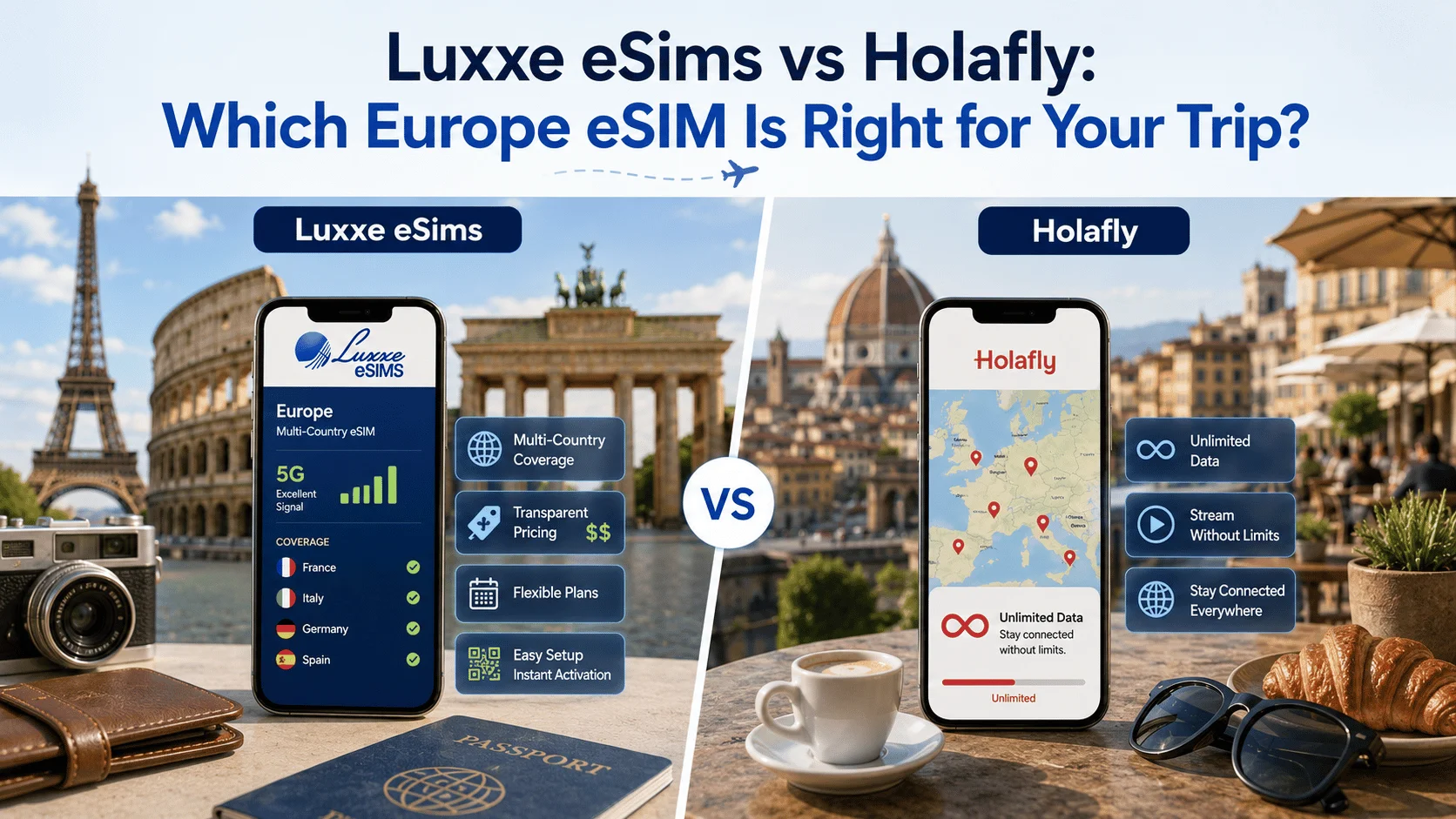
Luxxe eSims is the better pick if you want flexible, fixed data plans at a lower price, while Holafly suits...

A travel eSIM is a SIM card that is inserted in your smartphone, in such a way that it allows...

Staying connected while traveling used to be one of the most annoying parts of an international trip. You land in...